
DSCR Loans for Real Estate Investors: Complete Guide
DSCR Loans for Real Estate Investors: How They Work and What Options May Be Available
Last reviewed/updated: August 11, 2026
For many real estate investors, qualifying for financing is not always as simple as showing a salary and calculating a traditional debt-to-income ratio.
Investors may own multiple properties, operate businesses, take legitimate tax deductions, or have income that does not fit neatly into conventional mortgage underwriting.
A DSCR loan — Debt Service Coverage Ratio loan — takes a different approach.
Rather than relying primarily on traditional personal-income documentation, DSCR financing generally evaluates whether the investment property's qualifying rental income can support its applicable housing obligation. Current DSCR lender materials describe these programs as financing designed specifically for real estate investors and centered on property cash flow.
That can make DSCR financing worth exploring when purchasing, refinancing, or accessing equity from rental real estate.
But there is something investors should understand from the beginning:
There is no single universal DSCR loan.
Programs can differ significantly in credit requirements, leverage, property eligibility, rental-income calculations, reserves, loan amounts, and other underwriting rules. Some programs can even accommodate scenarios such as short-term rentals, non-warrantable condos, LLC vesting or specialized multifamily properties.
Understanding those differences can be just as important as understanding the DSCR calculation itself.
What Is a DSCR Loan?
A DSCR loan is an investment-property financing option that generally qualifies the transaction primarily using the property's rental cash flow rather than traditional personal-income documentation.
DSCR stands for Debt Service Coverage Ratio.
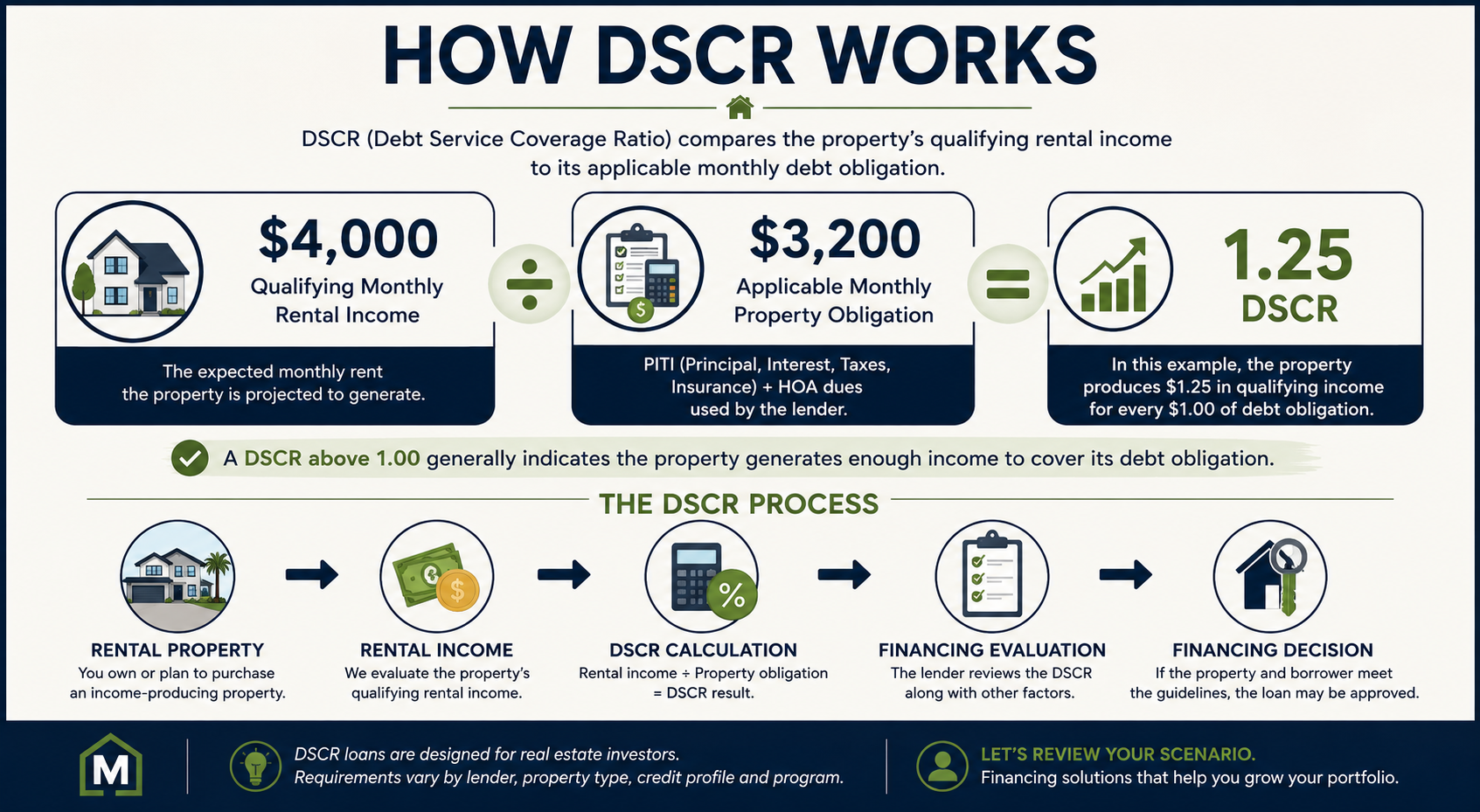
The ratio compares qualifying property income with the applicable monthly debt obligation used by the lender.
A simplified formula is:
DSCR = Qualifying Rental Income ÷ Applicable Property Debt Obligation
For example, imagine a rental property has:
Qualifying monthly rent: $4,000
Applicable monthly property obligation: $3,200
The simplified calculation would be:
$4,000 ÷ $3,200 = 1.25 DSCR
In this hypothetical example, the property produces $1.25 in qualifying rental income for every $1.00 of applicable debt obligation.
If the qualifying rent and applicable obligation were both $3,200, the ratio would be 1.00.
Actual lender calculations may differ based on how rental income and applicable property expenses are defined under the specific program, so this example is for educational purposes only. Deephaven, for example, describes DSCR as comparing monthly rental income with monthly debt obligations including principal, interest, taxes, insurance, and applicable association dues.
Why Real Estate Investors Consider DSCR Loans
The primary advantage is not simply reduced paperwork.
It's that the underwriting methodology may better reflect how an investment property operates as an income-producing asset.
Current DSCR programs may allow investors to qualify based primarily on subject-property rental income without traditional borrower income or employment documentation.
That can be particularly relevant for investors who:
are self-employed;
own multiple rental properties;
have significant business deductions;
have variable income;
want to continue expanding a real estate portfolio;
or simply have a financial profile that does not fit traditional mortgage underwriting particularly well.
That does not mean DSCR loans have no underwriting requirements.
Credit, assets, property eligibility, loan purpose, leverage, and lender-specific guidelines can still be important.
DSCR changes how a major part of the qualification is evaluated; it does not eliminate qualification.
DSCR Loans vs. Conventional Investment Property Financing
One of the biggest differences is how the borrower and property are evaluated.
Traditional conventional investment-property financing typically considers the borrower's qualifying personal income, liabilities, and other agency underwriting requirements.
DSCR financing places substantially more emphasis on the rental cash flow of the investment property. Current lender programs specifically describe DSCR financing as being underwritten based on subject-property rental income and permitting certain business-purpose structures.
Neither option is automatically better.
An investor with strong traditional income documentation may find conventional financing attractive.
Another investor may find that DSCR better matches the economics of the property and their financial profile.
The better question is:
Which financing structure makes the most sense for this property, this borrower, and this investment strategy?
Does Every DSCR Loan Require a 1.00 DSCR?
No. There is not one minimum DSCR requirement that applies universally to every lender and every program.
Different programs can establish different thresholds, and some investor-financing options may offer lower-ratio or no-ratio structures under specific circumstances.
That distinction matters because an investor should not automatically conclude:
“My property doesn't reach a 1.00 DSCR, so DSCR financing isn't possible.”
Instead, the complete scenario needs to be reviewed.
Credit profile, leverage, property type, transaction type, available assets and lender guidelines may all affect which options are available.
Considering a DSCR Property?
DSCR programs can vary considerably based on the property, rental strategy, credit profile, and investment objective.
Before you make an offer or restructure an existing investment property, reviewing the financing can help identify which DSCR structures may fit the scenario and which potential issues should be addressed early.
CTA: Discuss Your DSCR Scenario
DSCR Financing Can Go Beyond a Standard Purchase Loan
This is where DSCR becomes especially useful as an investor-financing category.
Depending on the lender and program, DSCR financing may be available for several different strategies.
Purchase Financing
Investors may use DSCR financing to acquire rental real estate while qualifying primarily through the property's qualifying rental income rather than traditional employment-income analysis.
Rate-and-Term Refinance
An existing investment property may potentially be refinanced into another financing structure using DSCR qualification.
Cash-Out Refinance
Certain DSCR programs provide cash-out refinance options, allowing investors to access equity from eligible investment properties. Current Deephaven wholesale materials, for example, include cash-out solutions within its DSCR offering.
Accessing equity can create additional investment flexibility, but additional leverage should still be evaluated in the context of the property's cash flow and the investor's broader strategy.
DSCR Second Mortgages
DSCR financing is no longer limited to first mortgages.
Specialized second-lien programs exist that allow qualifying investors to access equity while retaining an existing first mortgage. Deephaven currently publishes a DSCR second-mortgage program based on subject-property cash flow.
This can be particularly relevant when an investor wants access to equity but does not necessarily want to replace the existing first mortgage.
Can You Use a DSCR Loan for Airbnb or Short-Term Rentals?
Some DSCR programs allow short-term rentals.
That can make these programs relevant for properties operated through platforms such as Airbnb or VRBO, depending on the lender's documentation and property requirements.
Deephaven currently publishes DSCR guidance specifically addressing short-term-rental properties, and its DSCR materials state that both short- and long-term rental scenarios may be eligible.
For Florida investors, however, there is another important layer.
Financing eligibility does not determine whether a property may legally operate as a short-term rental.
Investors should separately investigate local ordinances, condo restrictions, HOA rules, and other applicable property requirements before relying on a short-term-rental strategy.
Can a DSCR Loan Be Closed in an LLC?
Some DSCR programs permit eligible LLC borrowing or LLC vesting.
Current Deephaven wholesale DSCR materials specifically include domestic LLC vesting and LLC entity options.
This can be important for real estate investors who hold rental properties through business entities.
However, financing through an LLC does not mean legal, tax, or liability questions disappear.
Investors should consult qualified legal and tax professionals regarding the appropriate ownership structure. A mortgage professional can explain financing requirements but should not determine an investor's legal or tax structure.
What Types of Properties Can DSCR Financing Cover?
Property eligibility varies widely by program.
Depending on the lender, DSCR financing may potentially be available for:
Single-family investment properties
Townhomes
Condominiums
2–4 unit properties
Certain non-warrantable condos
Rural properties
Short-term rentals
Larger residential investment properties through specialized programs
For example, current Deephaven wholesale materials include 1–4 unit DSCR financing and a separate DSCR program for larger multifamily properties.
What About Non-Warrantable Condos?
This can be particularly relevant for Florida investors.
Some non-QM and DSCR programs permit financing for certain non-warrantable condominium projects. Deephaven currently includes non-warrantable condo options within its investor-financing lineup.
That doesn't mean every condo will qualify.
Project characteristics, insurance, assessments, occupancy, and lender-specific requirements may still matter.
For a Florida condo investor, reviewing both the borrower financing and the condominium project before making an offer can help uncover potential financing issues earlier.
Can First-Time Investors Use a DSCR Loan?
Potentially, yes.
DSCR financing is not necessarily limited to experienced landlords with large portfolios. Some current lender programs specifically permit first-time real estate investors.
That can make DSCR worth exploring for someone purchasing a first rental property.
But qualifying for a mortgage and making a sound investment are two different things.
Investors should independently evaluate considerations such as:
potential vacancy;
repairs and maintenance;
insurance;
property taxes;
association fees;
property management;
and unexpected capital expenses.
Loan eligibility should never be interpreted as a guarantee that a property will be profitable.
What Credit Score Is Needed for a DSCR Loan?
There is no universal minimum FICO score for every DSCR loan.
Credit requirements can differ between lenders and may also change based on factors such as LTV, loan size, DSCR, property type, and transaction type.
Current lender materials illustrate that DSCR credit thresholds differ by program. For example, Deephaven's published wholesale materials show different minimum credit requirements among its first-lien, multifamily and second-lien DSCR products.
Rather than asking only:
“What is the minimum credit score?”
a more useful question is:
“Given my credit, property, rental income and available down payment or equity, which DSCR options may fit my scenario?”
How Much Down Payment Is Required for a DSCR Loan?
There is no single down-payment requirement that applies to every DSCR program.
Available LTV can depend on:
credit profile;
purchase versus refinance;
property type;
DSCR;
loan amount;
investor experience;
cash-out requirements;
and lender guidelines.
Current published DSCR offerings show that leverage can vary substantially across products and scenarios.
This is one reason it can be valuable to review financing before choosing between several investment properties.
Advanced Investors: Financing a Portfolio Instead of One Property at a Time
As an investor's portfolio grows, the financing question can change.
Instead of asking:
“How do I finance this rental?”
the question may become:
“How should I structure financing across the portfolio so I can continue acquiring properties?”
Specialized investor programs can include portfolio or cross-collateral structures involving multiple eligible properties.
These structures can potentially provide flexibility for experienced investors, but they also require careful analysis because several properties may secure one financing arrangement.
That can affect future sales, refinances, and portfolio decisions.
For investors reaching that stage, financing strategy becomes part of portfolio strategy.
When a DSCR Loan May Be Worth Exploring
DSCR financing may deserve consideration if you:
are purchasing rental real estate;
own multiple investment properties;
are self-employed or have complex income;
want property cash flow to play a central role in qualification;
are considering a short-term rental;
want to finance an eligible property through an LLC;
are exploring a cash-out refinance;
want to access investment-property equity;
or own a property that may not fit typical agency financing.
None of these situations automatically means DSCR is the best option.
They mean DSCR should be compared with the other financing structures available to you.
Important DSCR Considerations Before You Move Forward
Loan Costs
Non-QM financing may be priced differently from traditional conventional financing. Investors should evaluate the complete financing structure rather than focusing only on qualification.
Prepayment Provisions
Certain business-purpose investment loans may include prepayment provisions where permitted. Investors anticipating an early sale or refinance should review these terms carefully.
Property Cash Flow
Being able to qualify for financing does not mean a property is necessarily a good investment.
Liquidity
Even when a program does not require substantial reserves, investors should independently consider liquidity for vacancy, repairs, and unexpected expenses.
Property Eligibility
Short-term rentals, non-warrantable condos, mixed-use properties, acreage and unusual properties may involve additional underwriting considerations.
Guidelines Change
DSCR guidelines are highly lender- and investor-specific.
Credit requirements, leverage, loan amounts, rental-income calculations and property eligibility can change. Investors should review the current program available for the specific transaction rather than relying on an old flyer, social-media post or article.
Frequently Asked Questions About DSCR Loans
Do DSCR loans require tax returns?
Many DSCR programs do not use traditional personal-income or employment documentation because qualification focuses primarily on the rental cash flow of the subject investment property. Exact documentation depends on the specific lender and transaction.
Do DSCR loans use personal debt-to-income ratios?
DSCR financing generally focuses more heavily on property cash flow than the traditional borrower DTI methodology used by many consumer mortgage programs. Requirements remain lender-specific.
Can a DSCR below 1.00 qualify?
Potentially, depending on the program. DSCR thresholds are not universal, and available options may change based on the complete transaction.
Can DSCR loans finance short-term rentals?
Some programs can. Lender guidelines determine how short-term-rental income and property eligibility are evaluated.
Can I use an LLC?
Some programs permit eligible LLC borrowing or vesting.
Can a first-time investor use DSCR?
Some DSCR programs permit first-time investors.
Can DSCR be used for a cash-out refinance?
Yes, certain DSCR programs offer cash-out refinancing for eligible investment properties.
Are DSCR loans only for single-family properties?
No. Depending on the program, eligible properties can include additional residential property types and specialized multifamily scenarios.
The Right DSCR Strategy Depends on More Than the Ratio
DSCR financing can give real estate investors another way to structure a transaction around the investment property's cash flow rather than relying exclusively on traditional personal-income qualification.
But the flexibility is exactly why program selection matters.
A first-time investor purchasing a long-term rental may need a very different structure from an experienced investor accessing equity, purchasing a short-term rental, financing a Florida condo or managing a larger portfolio.
Before finalizing the transaction, it can be helpful to review:
the property + expected rental income + credit profile + available capital + investment objective + exit strategy.
That broader review can reveal financing options — and potential issues — that aren't obvious from looking at the DSCR number alone.
If you're considering purchasing, refinancing, or accessing equity from an investment property, I can help you review your scenario and understand which financing options may be worth exploring.
Ready to Review a DSCR Scenario?
Every borrower, property, and investment strategy is different. Loan eligibility and terms are subject to borrower qualifications, property eligibility, lender/investor guidelines, and other applicable requirements.
Educational Disclaimer: This content is provided for general educational and informational purposes only and is not intended as legal, tax, investment, or individualized financial advice.