FHA Down Payment Assistance: 100% Financing and Closing Cost Options for Homebuyers
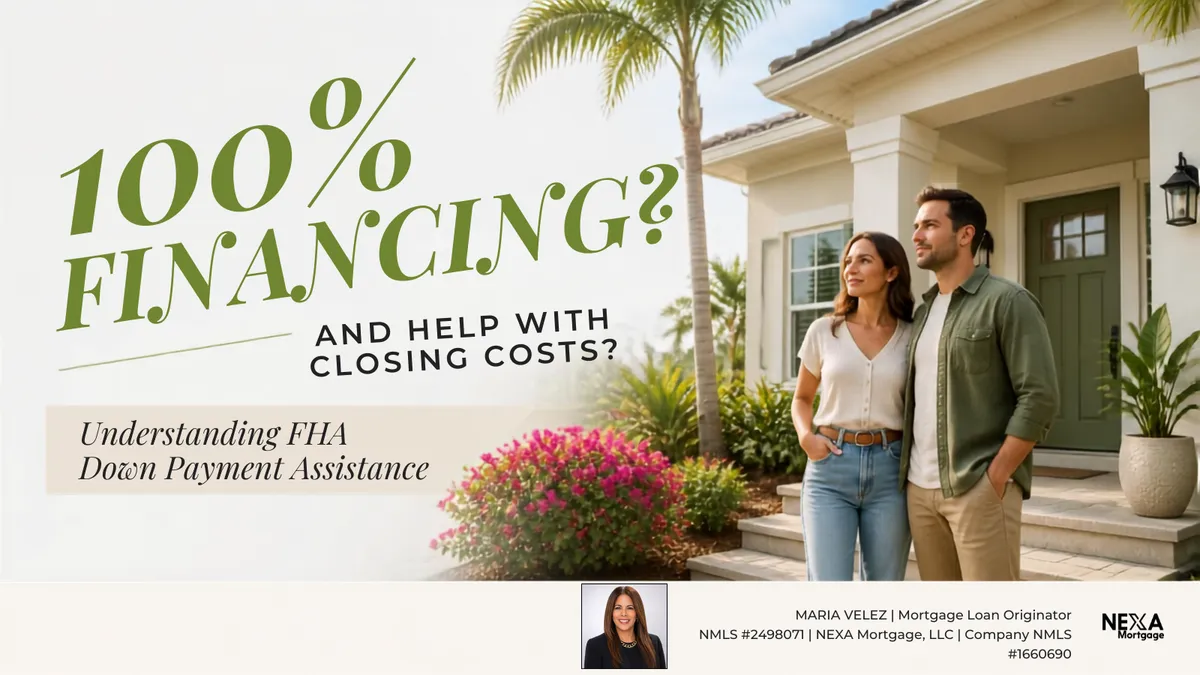
FHA Down Payment Assistance: 100% Financing and Closing Cost Options for Homebuyers
Could the biggest obstacle to buying a home be the cash needed at closing—not the monthly payment?
Many prospective homebuyers assume they need a large amount of money saved before they can even consider purchasing a home.
But that isn't always the case.
A buyer may have stable income, qualifying credit, and the ability to manage a mortgage payment—yet still hesitate because of the down payment and closing costs required to complete the purchase.
That's where understanding today's FHA Down Payment Assistance (DPA) options can make a significant difference.
Depending on the program and borrower qualifications, certain DPA structures may provide enough assistance to cover the FHA minimum required investment. Some programs may even provide additional assistance that can potentially be applied toward eligible closing costs.
For the right borrower and program, that can mean 100% combined financing—and, in certain structures, up to 101.5% combined loan-to-value (CLTV).
But those numbers need to be understood correctly.
Let's look at how these financing structures work, what options may be available, and what buyers should consider before deciding whether Down Payment Assistance is the right strategy.
What Is FHA Down Payment Assistance?
For eligible borrowers, an FHA loan may allow a minimum required investment of 3.5%.
Down Payment Assistance can provide eligible borrowers with funds that may be used toward that required investment and, depending on the specific program, potentially toward eligible closing costs.
The assistance is typically combined with the FHA first mortgage.
That distinction is important because when you hear terms such as “100% financing,” it doesn't necessarily mean the FHA first mortgage itself finances 100% of the purchase price.
Instead, the financing may involve:
FHA First Mortgage + Down Payment Assistance = Combined Financing
This is measured using Combined Loan-to-Value, or CLTV.
How Can FHA DPA Provide 100% Combined Financing?
Consider a simplified example.
$400,000 Purchase Price
A 3.5% minimum required investment would equal:
$14,000
An FHA first mortgage may finance up to 96.5% of the applicable value, subject to FHA requirements.
If an eligible Down Payment Assistance program provides the remaining 3.5%:
96.5% FHA First Mortgage
+ 3.5% Down Payment Assistance
= 100% CLTV
The DPA may therefore provide the funds needed to satisfy the minimum required investment.
For a qualified buyer whose primary obstacle is accumulating funds for the down payment, this type of structure could significantly reduce the amount of personal savings needed upfront.
However, the down payment isn't the only expense involved in purchasing a home.
Closing costs and prepaid expenses also need to be considered.
And that's where another type of DPA structure can become particularly interesting.
What Does 101.5% CLTV Mean?
Certain FHA Down Payment Assistance programs may provide assistance equal to 5% of the purchase price.
Using the same hypothetical $400,000 purchase:
5% assistance = $20,000
The 3.5% minimum required investment equals:
$14,000
That leaves a difference of:
$6,000
or approximately 1.5% of the purchase price.
Under a program that permits it, those additional assistance funds may potentially be applied toward eligible closing costs.
The combined structure could therefore look like:
96.5% FHA First Mortgage
+ 5% DPA
= 101.5% CLTV
This does not mean the FHA first mortgage is financing 101.5% of the home's purchase price or value.
It means the first mortgage and eligible subordinate assistance together may reach a combined loan-to-value of 101.5%.
That's an important distinction.
Can Down Payment Assistance Help With Closing Costs?
Potentially, yes.
Depending on the program, assistance beyond the amount needed to satisfy the minimum required investment may be eligible to help cover certain closing costs.
However, buyers should never assume that a DPA program automatically means “zero cash to close.”
A transaction may still include prepaid expenses, escrow funding, homeowners insurance, inspections, deposits, or other costs that need to be considered.
The exact amount needed at closing depends on the entire transaction.
That's why the better question isn't:
“Can I buy a house with zero dollars?”
It's:
“What would my actual cash-to-close requirement be based on the financing options available to me?”
Not All Down Payment Assistance Programs Are the Same
One of the biggest misconceptions about DPA is that it's a single government program with one universal set of rules.
It isn't.
There are multiple types of assistance programs, and their terms can differ significantly.
Here are some of the structures buyers may encounter.
1. 3.5% Down Payment Assistance
Some FHA DPA programs may provide assistance equal to the minimum required investment.
When combined with an eligible FHA first mortgage, this can potentially create a 100% CLTV financing structure.
This may be useful for borrowers who can afford the ongoing mortgage obligation but need help overcoming the upfront down-payment requirement.
2. 5% Down Payment Assistance
Certain programs may provide assistance equal to 5% of the purchase price.
Because the minimum required investment may be 3.5% for eligible FHA borrowers, the additional assistance may potentially be used toward eligible closing costs when permitted by the specific program.
This can result in combined financing of up to 101.5% CLTV.
3. Repayable Down Payment Assistance
Some DPA programs are structured as subordinate financing.
The assistance may have its own interest rate, monthly payment, and repayment terms.
This can reduce the amount of money needed upfront, but the additional obligation needs to be considered when evaluating the borrower's overall affordability and financing strategy.
4. Forgivable Down Payment Assistance
Other programs may offer assistance that becomes forgivable after specific requirements are satisfied.
For example, forgiveness may depend on remaining in the home for a specified period.
Selling, refinancing, moving out of the property, or paying off the mortgage before the forgiveness requirements have been satisfied may potentially trigger repayment of some or all of the assistance.
For that reason:
“Forgivable” does not necessarily mean “immediately free.”
The terms should always be reviewed carefully.
Do You Have to Be a First-Time Homebuyer to Receive DPA?
Not necessarily.
This is one of the most common misconceptions surrounding Down Payment Assistance.
Some programs are specifically designed for first-time homebuyers.
Others may allow repeat homebuyers to qualify.
Even programs that require first-time homebuyer status may use a definition that differs from what consumers expect.
For certain programs, a borrower who previously owned a home may potentially qualify as a first-time buyer if they haven't owned a primary residence during a specified period.
Program requirements vary, so previous homeownership shouldn't automatically cause someone to assume they aren't eligible.
Are There Income Limits for Down Payment Assistance?
Some programs have household income limits.
Others may have different income requirements or may not impose a program-specific income limit.
This is another reason buyers shouldn't automatically assume DPA is only available to lower-income households.
When applicable, eligibility requirements may consider factors such as:
Property location
Household income
Household size
Area median income
Property type
Occupancy
Loan program
Individual DPA requirements
The only reliable way to determine potential eligibility is to evaluate the specific programs available for the borrower and transaction.
What Credit Score Do You Need for FHA Down Payment Assistance?
There is no single credit-score requirement that applies to every DPA program.
FHA eligibility requirements apply to the first mortgage, while individual assistance programs and lenders may establish additional requirements or overlays.
Depending on the financing structure, qualification may also consider:
Credit history
Debt-to-income ratio
Automated underwriting findings
Employment and qualifying income
Assets and reserves
Property eligibility
Occupancy
The borrower's overall financial profile
That's why a credit score by itself doesn't provide the complete answer.
DPA Isn't the Only Way to Reduce Cash Needed at Closing
This is where mortgage planning becomes especially important.
If a buyer doesn't have enough cash to comfortably complete a purchase, Down Payment Assistance may be one solution—but it isn't necessarily the only solution.
Depending on the transaction, several strategies may be worth evaluating.
Down Payment Assistance
DPA may provide eligible funds toward the minimum required investment and, depending on the program, potentially toward eligible closing costs.
Seller Contributions
Subject to applicable loan-program requirements and the transaction, a seller may contribute toward certain allowable closing costs and prepaid expenses.
Low-Down-Payment Mortgage Options
Some borrowers may qualify for mortgage programs requiring relatively small down payments without using DPA.
Temporary Rate Buydowns
When permitted, eligible contributions may potentially be used to fund a temporary interest-rate buydown, reducing the borrower's payment during the initial period of the mortgage.
A Combination Strategy
Sometimes the strongest solution involves more than one tool.
For example, an eligible transaction might combine a low-down-payment mortgage, DPA, and allowable seller contributions.
The goal is not simply to find the program advertising the largest amount of assistance.
The goal is to determine which financing structure makes the most financial sense for the individual buyer.
Is Down Payment Assistance Always the Best Option?
No.
And that's an important part of making an informed decision.
Reducing the amount of money needed at closing can be valuable, but assistance may involve trade-offs.
Depending on the program, those could include:
A second mortgage
An additional monthly payment
Different interest rates or pricing
Repayment requirements
Forgiveness periods
Occupancy requirements
Restrictions or repayment triggers associated with selling or refinancing
Higher overall borrowing costs
A buyer with sufficient savings may determine that using personal funds produces a stronger overall financial outcome.
Another buyer may benefit significantly from preserving savings and using DPA.
Neither strategy is automatically right or wrong.
The answer depends on the borrower's circumstances, available programs, and financial goals.
A Better Way to Think About Home Affordability
Homebuyers often begin with one question:
“How much money do I need to buy a house?”
A more useful conversation considers several questions together:
How much cash will I actually need at closing?
What will my estimated monthly housing payment be?
How much money will I have left in savings after closing?
Could Down Payment Assistance reduce my upfront costs?
Could seller contributions help?
What are the short- and long-term costs of each financing option?
How long do I expect to own the property?
Those questions provide a much more complete picture of affordability than focusing only on the down payment.
Frequently Asked Questions About FHA Down Payment Assistance
Can FHA Down Payment Assistance provide 100% financing?
Certain DPA structures may provide assistance equal to the FHA minimum required investment, potentially resulting in 100% combined loan-to-value (CLTV) when paired with an eligible FHA first mortgage. Qualification and program requirements apply.
What is 101.5% CLTV FHA financing?
Certain DPA programs may provide assistance of up to 5% of the purchase price. When combined with an FHA first mortgage financing up to 96.5% of the applicable value, the combined financing may potentially reach 101.5% CLTV. Depending on the program, assistance beyond the minimum required investment may potentially be applied toward eligible closing costs.
Can DPA help pay closing costs?
Some programs may allow assistance funds beyond the amount needed for the minimum required investment to be applied toward eligible closing costs. Program rules vary.
Do I need to be a first-time homebuyer?
Not always. Some DPA programs accept repeat buyers, while others have specific first-time homebuyer requirements.
Does DPA have income limits?
It depends on the program. Some have income limits, while others may have different eligibility requirements or no program-specific income limit.
Is Down Payment Assistance free money?
Not necessarily. Depending on the program, DPA may be structured as repayable subordinate financing, deferred assistance, a grant, or assistance that becomes forgivable after specified requirements are met.
Can DPA be combined with seller contributions?
Potentially. Depending on the loan program, DPA program, transaction, and applicable guidelines, allowable seller contributions and DPA may both be part of the financing strategy.
Before You Assume You Need More Time to Save, Know Your Options
There are situations where waiting is absolutely the right decision.
A buyer may need time to improve credit, reduce debt, build emergency reserves, or strengthen their overall financial position.
But not having a large down payment doesn't automatically mean someone isn't ready to explore homeownership.
Today's mortgage market offers multiple ways to structure financing.
For some eligible buyers, that may include 100% combined financing.
For others, certain FHA DPA structures may potentially provide assistance toward both the minimum required investment and eligible closing costs.
And for some buyers, using their own funds or choosing another financing strategy may ultimately make more sense.
The important part is knowing the difference.
Thinking About Buying but Concerned About the Down Payment or Cash Needed at Closing?
Before assuming you need another year to save, let's look at the numbers.
I can help you review potential mortgage and Down Payment Assistance options, estimate your cash-to-close requirements, and compare financing strategies based on your individual situation.
Explore Your Homebuying Options
Maria Velez
Mortgage Loan Originator | NEXA Mortgage
NMLS #2498071 | Company NMLS #1660690
maria-velez.com
For educational purposes only. This information is not a commitment to lend or a guarantee of financing, program availability, or qualification. Down Payment Assistance programs, funding, credit requirements, income limits, interest rates, repayment terms, forgiveness provisions, and eligibility requirements vary and are subject to change. FHA and other mortgage programs are subject to applicable agency, investor, lender, and program guidelines. Additional restrictions and conditions may apply.